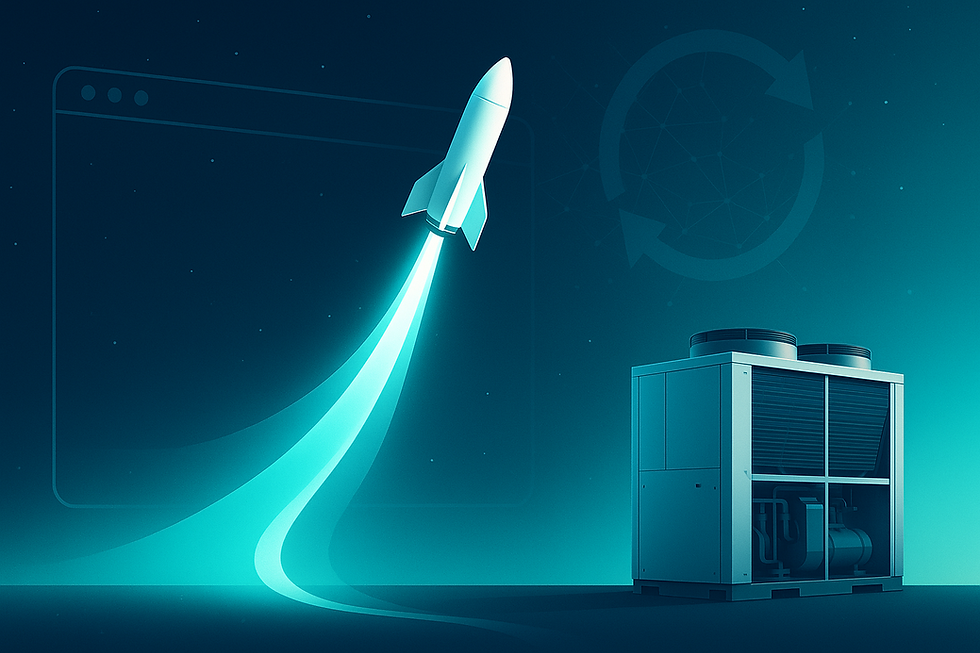
Beyond Industry 4.0: Welcome to the Outcome Economy with Cooling as a Service

Updated: Sep 9
Why servitization is the key to overcoming the challenges of the Fifth Industrial Revolution

We are on the cusp of the fifth industrial revolution, but to enter this new world, we as businesses are required to make a paradigm shift. The 5.0 era is demanding: it is not content with us doing what we did before, only better. It wants greater benefits for workers, for society, and consequently, for the environment.
The real leap is not technological, but one of business models: we are entering the outcome economy. Industry 4.0 created the digital twin of everything, allowing us to extrapolate vast amounts of data and increase production efficiency. But this is no longer enough in a world where industry, people, and the planet all want to win simultaneously.
This is where servitization comes into play. It is a model that ushers everyone into an era of abundance through a true circular economy, where waste is not recycled at the community's expense but remains a valuable asset for its own producer, ready to be rebuilt into goods to be leased out again at the highest possible efficiency, designed to last as long as possible and thus generate the most profit.
How Cooling as a Service Brings This Vision to Life
The old "lowest price" mentality and capital expenditures (CapEx) are swept away by this new service-based model. It's a model that values the highest product quality and the professionalism of people, democratizing access to technologies that "do more with less."
EUCOS anticipates this revolution by servitizing cooling and heating infrastructures. We offer companies direct access to a guaranteed outcome, freeing them from the ownership of the asset that is supposed to provide it. Here’s how, in practice:
Financial Convenience and Predictability
Instead of tying up capital in an asset that depreciates over time, you pay only a fixed monthly fee. Whatever happens—a breakdown, an extraordinary maintenance event—the cost does not change. This eliminates spending peaks and transforms an unpredictable capital cost into a transparent and controllable operating expense (OpEx).
Sustainability and Energy Efficiency
Our success is aligned with yours and with the planet's. Since we retain ownership of the asset, we are the first to be incentivized to provide you with only the most efficient technologies on the market. Lower energy consumption reduces your operating expenses while reinforcing the value of our service. For EUCOS, it reflects a properly sized, maintained, and managed asset that remains highly reliable and far less susceptible to breakdowns and wear. At contract end—should the equipment be returned—units are reconditioned and redeployed whenever technically viable, extending asset lifecycles and significantly lowering overall environmental impact.
Practicality and Operational Intelligence
Your business is to create value, not to manage equipment. With our service, air conditioning ceases to be your concern. We monitor the equipment remotely 24/7, and in case of an anomaly, we often intervene before you even notice. Routine maintenance, extraordinary repairs, and regulatory compliance become our responsibility.
This allows you to dedicate 100% of your resources to your core business, with the certainty that your critical infrastructure is always performing at its peak.
The Service That Wasn't There Before
EUCOS Cooling as a Service is more than just an operating lease. It is the practical application of the principles of the Fifth Industrial Revolution: a service that aligns the interests of the provider, the client, and the environment, creating an ecosystem where everyone wins.
Author's Note: This article is an expanded version of an analysis first shared on my LinkedIn profile on May 8, 2022, read the original article here.